You catch your profile in a photograph or on a video call and notice fullness beneath the chin. The assumption arrives at once: too much fat. It is a reasonable guess, and it is often only partly right.
Skin that has lost firmness, the chin’s position, and the neck’s angle can all create the same shadow. Two people can describe an identical concern and need very different plans.
That is why the surgical versus non-surgical question has no simple answer, and why any double chin treatment starts with working out what is creating the fullness.
Once the cause is clear, the options sort themselves out more easily than most people expect.
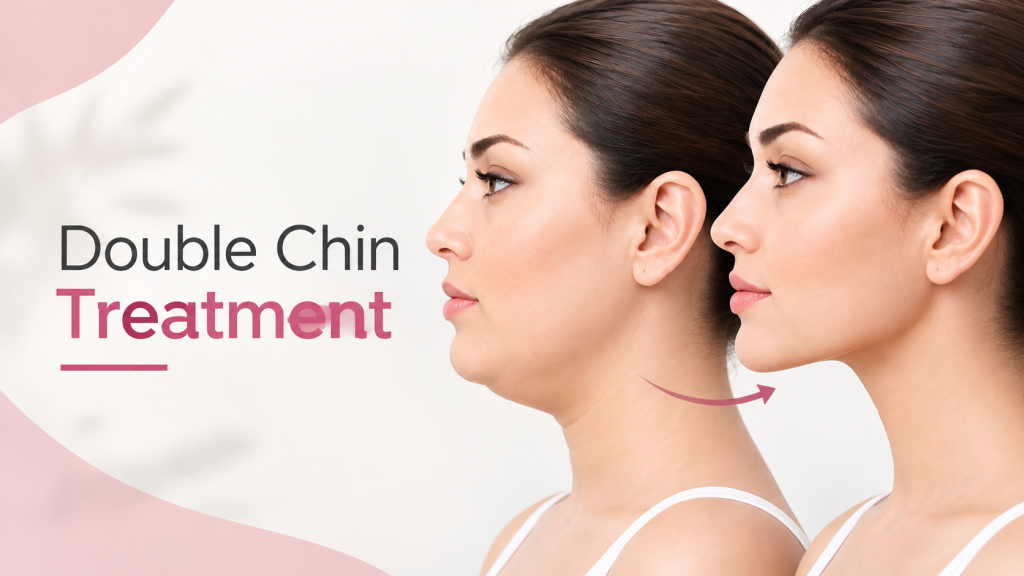
A Double Chin Is Not Always Just Fat
“Double chin” describes an appearance, not a single anatomical problem.
Localized fat, loose skin, age-related tissue changes, a recessed chin, lower jaw anatomy, neck tissues, and overall facial proportions can each contribute, alone or together.
What the patient sees is not always what the treatment needs to correct. Assessment now weighs fat volume, skin quality, chin projection, jawline definition, and profile together.
Unde rstanding the Main Double Chin Causes
Genetics often set the pattern, deciding where a person stores fat and how the chin and jaw are built. Aging then loosens skin and shifts deeper tissues, and weight changes can add or reveal fullness.
A slim person can have this fullness too, because double chin causes include bone structure and skin quality as much as fat.
How to Remove Double Chin: Start With the Cause
Patients often ask how to remove a double chin, but the answer depends on what is creating the fullness. The treatment has to correspond to the tissue responsible. Broadly:
- Fat-dominant fullness may call for fat reduction.
- Mild laxity may make tightening relevant.
- Greater skin excess can require a different clinical discussion.
- Chin projection can affect the profile independently of fat volume.
Surgical Double Chin Treatment: What Liposuction Can Change
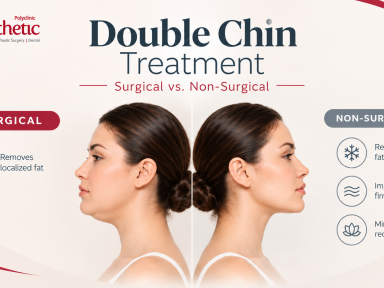
Submental liposuction physically removes localized fat through a small incision. That allows a more direct contour change than waiting on the body’s gradual response to a non-surgical option.
It may suit patients whose fullness is mostly fat and whose skin elasticity is good.
Fat removal changes volume. How the contour settles then depends on skin elasticity and the tissue left behind. Chin proection and lower-face anatomy still shape the final profile.
Recovery usually includes swelling, bruising, and a period of compression. The risks include contour irregularity or asymmetry. Liposuction alone does not correct significant loose skin, so patient selection matters.
Patients should ask about anesthesia, compression garments, and how long visible swelling may last.
Double Chin Removal Non Surgical: What It Can and Cannot Do
Non-surgical is not one treatment. Different technologies act on different tissues, so they are not interchangeable, and none of them is risk-free.
Injectable Fat Reduction and Cryolipolysis
Injectable treatments are designed to reduce targeted fat through a biological mechanism. Cryolipolysis uses controlled cooling to affect localized fat. Both work gradually and do not necessarily match the contour change of physical removal.
Treatment usually involves several sessions, with swelling, bruising, or tenderness along the way.
When Skin Tightening Matters More Than Fat Reduction
Energy-based treatments may be relevant when laxity contributes to the appearance. They target tissue firmness rather than acting as an equivalent substitute for substantial fat removal.
Firming the neck and reducing a double chin can be two different goals.
Double Chin Fat Removal Is Only Part of the Profile
Careful double chin fat removal cannot supply what the anatomy lacks. Taking out a small fat pocket does not necessarily create definition if the limiting factor is chin projection, skin laxity, lower jaw anatomy, or surrounding tissue.
Jawline contouring is therefore a related but separate question. A small fat pocket may matter little when the chin is recessed. A person with very little fat can still lack definition because of laxity or proportions.
Assessing the profile from the side, and in motion, often reveals contributors that a front-facing photograph hides.
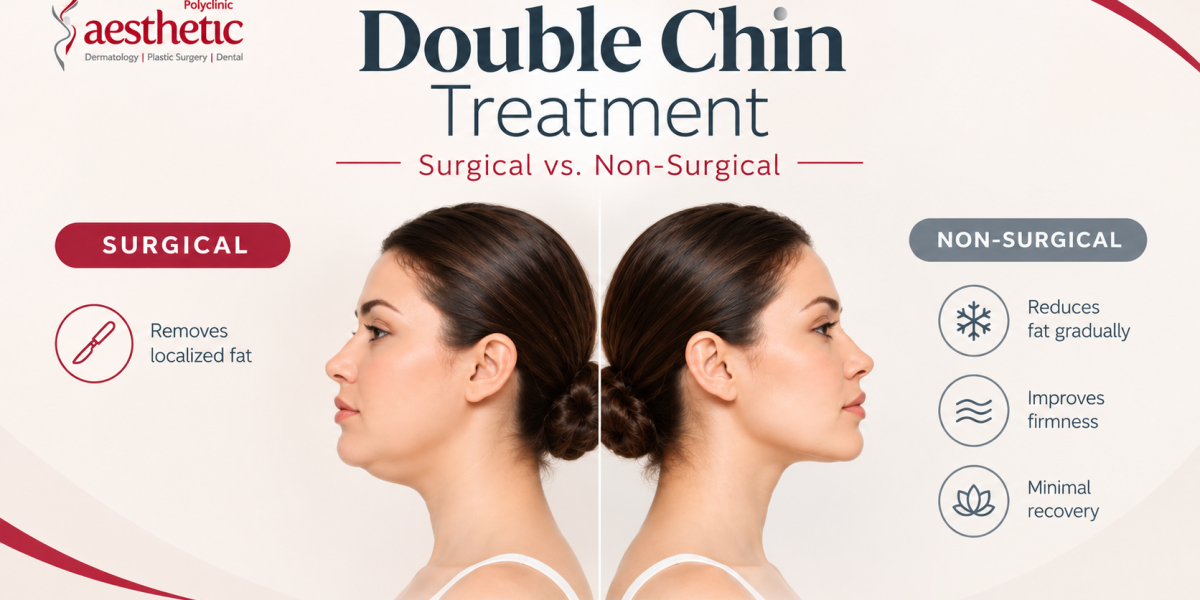
Surgical vs. Non-Surgical Double Chin Treatment: What Actually Changes?
Neither approach wins outright, because the better option shifts with what needs correcting.
| Factor | Surgical | Non-surgical |
| Fat | Can physically remove localized fat | Can reduce targeted fat gradually |
| Skin laxity | Some surgical approaches can address excess skin or tissue | Certain technologies target tissue firmness |
| Sessions | Often one procedure | Often staged over several sessions |
| Recovery | Usually more visible and structured | Depends on modality and treatment intensity |
| Main consideration | Degree of correction and anatomy | Cause, treatment response and desired change |
A table simplifies the options. An assessment determines where a given patient actually fits.
When the Choice Needs to Be More Personal
Anatomy is only half the decision. Anyone comparing double chin removal Dubai clinics is usually also weighing visible recovery against work, travel, filming, public appearances, and how much privacy matters.
Some patients lean toward a double chin removal non surgical plan to keep recovery less visible. Others would rather go through one structured surgical recovery than several lower-intensity sessions.
Neither is better in itself. The treatment that looks best on paper may not fit the patient’s actual life. Previous procedures, skin elasticity, chin projection, and the correction wanted all shaped the plan.
How to Decide Which Treatment Fits
Before booking a double chin removal Dubai consultation, these questions help turn a vague wish into useful answers:
- Is the fullness mostly fat, skin laxity or both?
- How much contour change am I actually seeking?
- Would tightening address part of the concern?
- Does my chin projection affect how I see my profile?
- How much recovery can I realistically accommodate?
- One structured procedure, or a gradual plan?
- What risks and limitations apply to each option?
This is preparation for an assessment, not a self-diagnosis.
Common Questions
Can you remove a double chin without surgery?
Selected non-surgical treatments can reduce localized fat or improve tissue firmness, depending on the cause and the method. They are not equivalent to surgical fat removal, and they may not suit fullness driven mainly by skin laxity or chin projection.
Does losing weight remove a double chin?
In some people, you can lose fat with weight loss, but you won’t be able to target the area under the chin. Genetics, skin laxity, facial structure, and how fat is distributed all contribute to persistent fullness.
How do the two approaches differ in durability?
Localized reduction can be permanent because the fat cells that are removed or destroyed will usually not come back. Visible contours can still change with aging, weight fluctuations, surrounding tissue changes, and individual biology. Surgery is usually one procedure, while non-surgical plans are often staged over several visits.
The Right Approach Starts With the Right Assessment
The useful question is not whether surgery or a non-surgical approach is better. It is what is creating the fullness, which tissue needs to change, how much correction is wanted, and what level of recovery fits the person’s life.
AestheticsCC approaches double chin treatment through individual assessment of fat, skin, anatomy, and profile proportions, helping patients understand which options may suit their concerns before deciding on a treatment plan.