The science of the skin has evolved past superficial treatments. Now, dermatology studies the biological signaling systems that regulate skin cell behavior, healing, and regeneration. One such system that has generated a lot of discussion in today’s skin science is the role of peptide signaling pathways, a more exact way of promoting collagen production and skin healing.
It is this cutting-edge science that Aesthetic Polyclinic utilizes in the design of a number of its advanced skin rejuvenation treatments, based on how skin behaves. Visit us and gain insight into how we use scientific research in skin care treatment plans.
Key Takeaways
- The peptide signaling pathway is an internal communication system that tells the skin cells how to make collagen and repair themselves.
- Peptide-based skin treatment conditions work with nature rather than against it.
- Skin cell signaling is key to the process of skin aging, healing, and renewal.
- All peptides do not have the same function but serve different biological purposes.
- An assessment process carried out at Aesthetic Polyclinic can help determine the best technique to be used.
What Are Peptide Signaling Pathways?
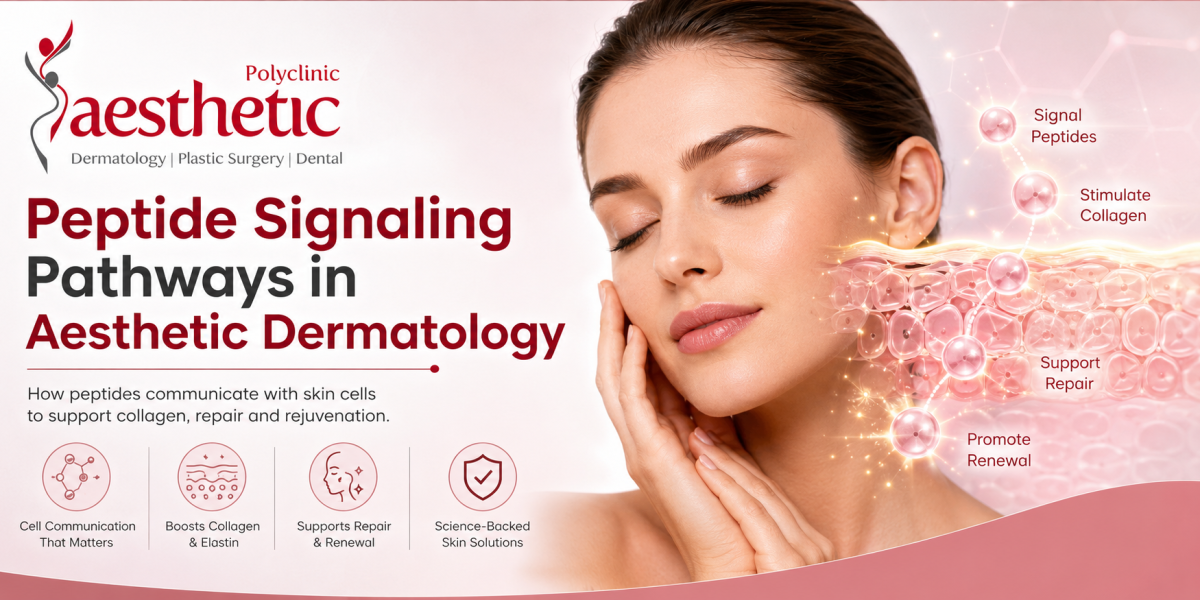
Peptides are short sequences of amino acids that communicate information from one cell to another. When peptides are used in topical treatments, they connect to the receptors of the skin and cause specific biological effects.
That is where this pathway works. These signaling pathways function as messaging processes that instruct the fibroblasts to produce collagen, facilitate tissue repair, or reduce inflammation. Knowledge about such internal communications has made it possible to plan a biological approach to treating skin problems.
How Do Peptides Affect Skin Cell Communication?
The skin is not just a “self-healing machine” acting randomly. All skin repair mechanisms, from tissue formation to collagen production, rely on skin cell signaling. Peptides serve as messengers in this process, causing cells to initiate their repair or rejuvenation processes.
Various peptides deliver various signals. Some promote collagen production, while others help to control melanin production or inhibit inflammation reactions. Such complexity of communication systems is one of the reasons why peptides are viewed as a more sophisticated technology than topical treatments.
Why is there a Growing Interest in Skin Care Products Based on Peptides?
There is an increasing interest in peptide-based skin treatments due to a search for products that are closer to nature and skin mechanisms. In other words, the focus now is on encouraging skin to heal itself rather than forcing it.
This is also of interest to those who would like something less dramatic, faster, and more biological. The reason for this lies in how peptides affect cellular communication and, thus, produce results.
Types of Peptides Used in the Treatment of Skin Problems
Peptides do not belong to one group only. Every kind gives different results in terms of biological process and the dermatology treatment problems can include various kinds of peptides.
- Signal peptides: stimulate the creation of collagen and elastin.
- Carrier peptides: assist in transporting trace elements, including copper, which promotes wound healing.
- Enzyme-inhibitor peptides: reduce the breakdown of already created collagen.
- Neurotransmitter-inhibitor peptides: reduce the appearance of fine expression lines.
It means that doctors can develop personalized programs taking into account the peculiarities of the specific skin type instead of applying some common methods.
Who Are These Treatments Suited For?
Individuals who have begun noticing initial signs of collagen breakdown, irregular texture, or a decline in skin regeneration rates are typically interested in pursuing treatments that focus on peptides. Given the nature of these treatments in slowly working with the natural body signals, they usually appeal to those people seeking a more controlled approach.
However, an individual’s skin type, medical background, and personal preferences play a big part in determining their suitability as well. Therefore, a consultation becomes even more important than a current popular trend.
Expectations from a Consultation
Before beginning apeptide-based treatment, there is normally an assessment of the patient’s skin. This gives the clinician the ability to get an idea of the skin’s current state, the state of the collagen, and any other issues.
- Review of the history of skin and current issues
- Collagen density and elasticity assessment
- Expectations and timeline discussion
- Customized plan based on individual signaling of the skin
It is through this process that the clinician can develop a customized treatment that matches the person’s skin biology.
Future of Skin Renewal
With increasing advancements in the field of dermatology, methods that use cell communication will become increasingly prominent when dealing with various skin conditions. Knowledge about peptide signaling provides a more intelligent, biology-based approach instead of going for a superficial fix.
Aesthetic Polyclinic has been keeping up with the latest developments in this sphere, providing people with the opportunity to deal with skin renewal through an intelligent process. Those who would like to learn more about these modern skin rejuvenation treatments can do so by visiting our website.
FAQs
Is there any skin that cannot benefit from peptides?
Most types of skin can be assessed for their suitability for peptide treatment, although different levels of sensitivity and skin conditions exist. The consultation process enables determination of whether someone’s skin is compatible with such an option of biological signaling.
How soon can one see any results?
The fact that this form of treatment uses natural signaling by the skin cells means that there will be no immediate visible effect. Most people experience improvement within weeks due to increased collagen production.
Do peptides replace any skin care regimen?
Not at all, since they usually complement a complete skin care routine. While peptides help with signaling inside the skin, other aspects of care like hydration and protection from the sun’s rays still matter.
Are there any downtime periods?
It is dependent on the specific approach. Numerous options for peptides are very minimal in terms of disruption to daily life, but this needs to be confirmed in the course of a one-on-one consultation.
What is the process of determining a proper peptide regimen?
They will evaluate your skin condition, collagen status, and goals before recommending an appropriate regimen. This is because the peptide signaling pathways respond to peptides differently, making personalization crucial.